Polymarket AI Agents: Architecting an Ultra-Low Latency Agent's Brain
TL;DR: The crypto and AI spaces are obsessed with "Agents," but most are just fragile Python scripts wrapping 2-second OpenAI API calls. If you want an agent to survive in High-Frequency Trading (HFT), it can't think like a chatbot. It needs the architecture of a biological nervous system: a blazing-fast Reflex Path for sub-100μs execution, and a slower Cognition Path for deep learning and memory consolidation. Here’s how we built it. (Repo link : https://github.com/bdieu178/poly8-cap-hft )
————————
Most "AI Agents" today are fundamentally broken for real-world execution.
They operate on a simple loop: Observe -> Send to LLM -> Wait 2 seconds -> Act. This works fine if you’re asking an agent to write a tweet or scrape a website. But if your agent is trading millions of dollars on a decentralized exchange, a 2-second delay isn't just slow—it's fatal.
In High-Frequency Trading, you don't have time to ask a massive language model what to do. You need an architecture that mimics biological life: you don't consciously "think" about moving your hand away from a hot stove; your spinal cord handles the reflex instantly, while your brain processes the pain a fraction of a second later.
To achieve our target of $20k/week in fully autonomous execution, we had to architect an agent with two distinct brains: The Reflex Path and The Cognition Path.
The Anatomy of an Autonomous Trader
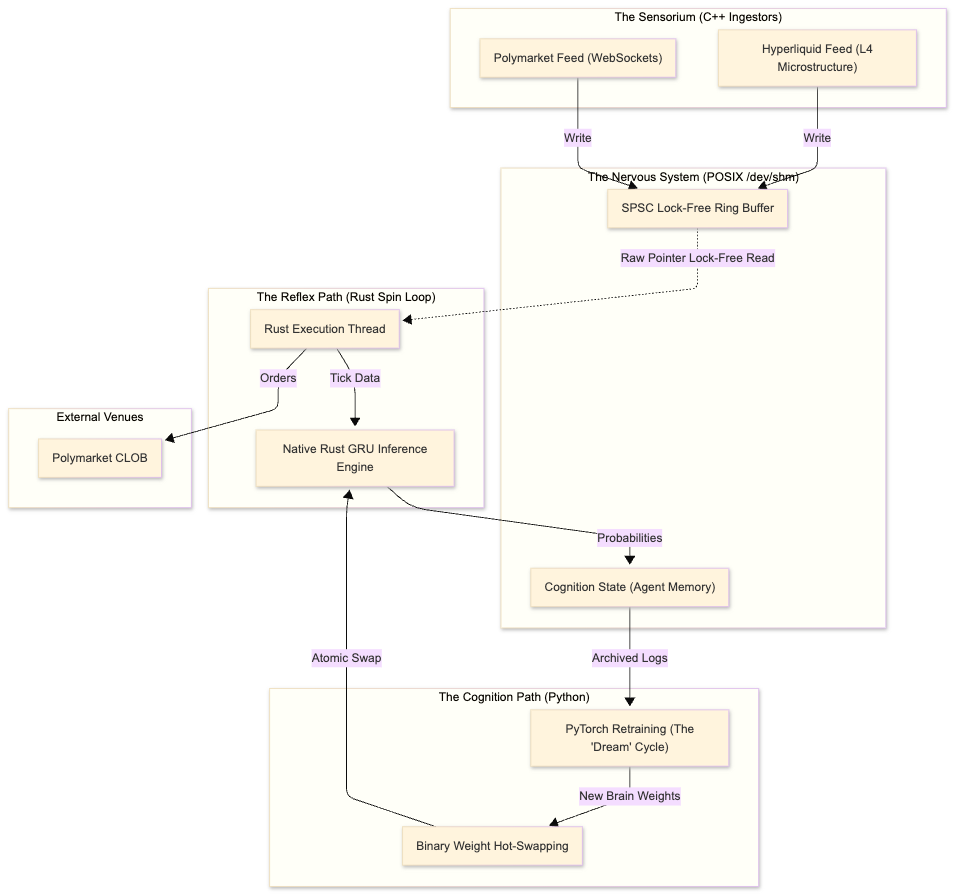
Here is the high-level architecture of our agent's brain & the surrounding harness. Data flows from the "Sensorium" (our C++ Ingestors tracking raw blockchain microstructure) through a zero-copy "Nervous System" directly into the agent's pre-compiled "Cortex."
The Reflex Path: Native Rust Neural Networks
The Reflex Path is the agent's spinal cord. It is entirely decoupled from anything slow, garbage-collected, or blocking.
Instead of calling an external AI model, the agent runs a Dual-Head Gated Recurrent Unit (GRU) written entirely in native Rust math kernels. There is no PyTorch, no TensorFlow, and no Python overhead on the hot path.
When a tick arrives from the Sensorium via the lock-free shared memory queue, the Rust Executor (spinning on an isolated CPU core) performs a matrix-vector product (Y=WX+BY=WX+B), updates the GRU cell equations, and outputs two distinct thoughts:
Directional Offset (signed_alpha): How mispriced is the current asset?
Regime Classification (nu_probs): Are we in a contrarian, neutral, or herding market?
Execution Time: The entire forward pass completes in under 100 microseconds. The agent assesses the microstructure, calculates the theoretical options pricing, and fires a limit order to the exchange before a human could even register the UI updating.
Context Windows as Short-Term Memory
In LLMs, the context window is the text history. In our agent, the context window is the RNN Hidden State.
During a flash crash, a simple linear model looks at an instantaneous price drop and assumes it's noise. But because our agent uses a GRU, the tanh activation function accumulates the institutional selling pressure over time within its hidden state.
Case Study: The Protracted Macro Bleed (June 3, 2026)
Over a grueling 50-second window, Bitcoin bled out $230 in value. The Polymarket Market Makers were asleep, holding their Asks steady. Because our agent's Reflex Path maintained a continuous memory of the toxic sell flow hitting the Hyperliquid orderbook, it recognized the bleed as a structural capitulation 40 seconds before the market makers did. It executed a Taker order precisely at the bottom, locking in a +45% ROI when the market makers finally panicked and repriced.
The Cognition Path: "Dreaming" and Hot-Swapping Brains
If the Reflex Path is the spinal cord, the Cognition Path is the deep cortex. A static model decays over time as market dynamics change. Our agent is an "Auto-Didact." Every tick it processes and every probability it calculates is pushed to a secondary memory segment and archived into Parquet files.
Every 6 hours, the agent goes into a "Dream Cycle":
A background Python process wakes up and reads the recent Parquet archives.
It retrains a heavy PyTorch model using walk-forward cross-validation against the newest market data.
It exports the newly trained neural network weights as a raw binary file (.bin).
The Zero-Downtime Swap: The agent performs an atomic symlink swap of the .bin file in production. The Rust spin-loop detects the file change and hot-loads its new "brain" between ticks. The agent learns, adapts, and overwrites its own neural pathways without ever dropping its websocket connections to the exchange.
————————
The Takeaway
We need to stop building "Agents" that rely on time.sleep() while waiting for an external server to generate a JSON response.
By separating the Reflexes (deterministic, math-only, bare-metal loops) from the Cognition (heavy training, deep learning, memory consolidation), you can build systems that are truly autonomous, insanely fast, and financially advantageous against the orderbook.